
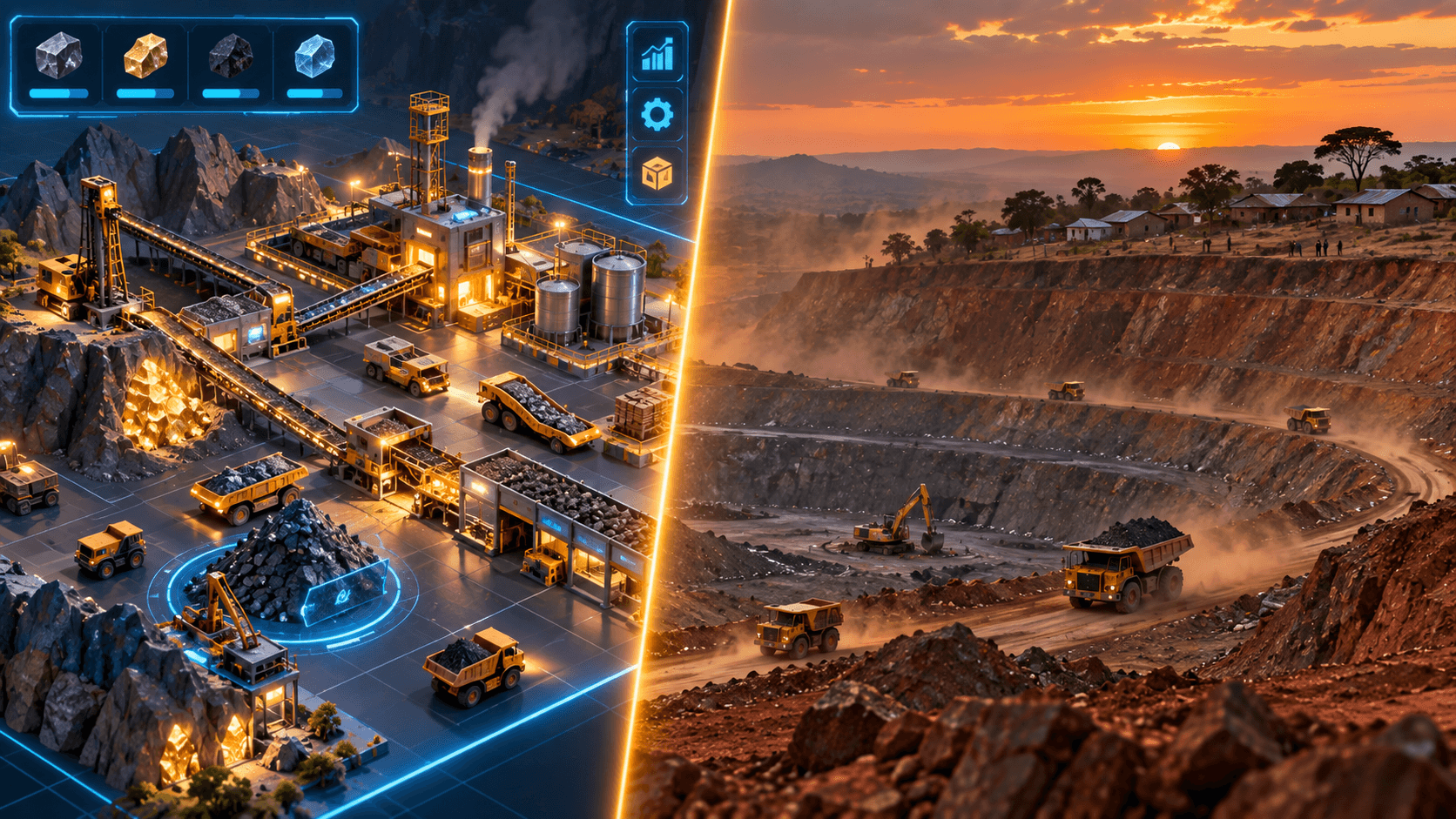
In Factorio, you automate graphite extraction in minutes. In Satisfactory, rare earth elements flow down conveyor belts with frictionless efficiency. In Deep Rock Galactic, you drop into alien caves, blast minerals from the walls, and extract with no regulatory delays, no community consultations, no tailings management liability. The mining genre is one of PC gaming’s most enduringly popular mechanics — and it is built on a complete abstraction of what resource extraction actually involves. The gap between the game and the reality is not merely technical. It is political, environmental, and human — and investigative outlets like mining investigations Tanzania platform Madini Today exist precisely to document what that gap looks like in one of the world’s fastest-expanding mining jurisdictions.
This article does two things simultaneously. It looks seriously at why mining mechanics are so compelling in PC games — what the best titles get right about systems thinking, resource chains, and the satisfaction of optimization. And it examines what those same games systematically omit: the human rights dimensions, the environmental costs, the corruption dynamics, and the community impacts that define real-world extractive industries. Tanzania’s mining sector, currently experiencing its most intensive development period in history, serves as the real-world counterpoint — the version of the mining game that plays out without respawn points or save states.
Why Mining Mechanics Work So Well in PC Games
The appeal of mining in games is not arbitrary. It connects to something genuine about the satisfaction of extraction and transformation — the cognitive pleasure of taking raw material from the environment and converting it, step by step, into something more complex and more valuable. This is systems thinking made visceral, and the best mining games reward the player for understanding and optimizing those systems with a precision that most real-time activities cannot match.
Factorio is the canonical example. You land on an alien planet, find ore deposits, build miners, run conveyor belts, smelt metal, construct assemblers, and progressively automate a production chain that scales from a single iron plate to a rocket launch. The genius of the design is that each stage of complexity reveals the next layer of interdependency — you cannot optimize one part of the system without understanding how it affects every other part. Players routinely report losing entire nights to this loop, and the game’s Steam rating after years of availability remains among the highest of any title on the platform.
Satisfactory takes the same core loop and renders it in three-dimensional first-person perspective, making the factory tangible in a way that Factorio’s top-down view cannot. Walking through a fully automated copper refinery you have built yourself — watching the miners extract, the conveyors carry, the smelters process, the constructors assemble — produces a satisfaction that its designers clearly understood when they described the experience as “factory building porn.” The resource chains involve ores, minerals, and processing steps that mirror real metallurgical sequences closely enough to feel educational.
Deep Rock Galactic takes a different approach: you are a dwarf miner employed by an intergalactic corporation, deployed into procedurally generated cave systems on the alien planet Hoxxes IV to extract minerals under time pressure while fighting hostile fauna. The cooperative multiplayer design — four players with complementary roles working together to mine, survive, and extract — captures something about the teamwork that real mining operations require, even as it strips away everything else that real mining involves. Deep Rock Galactic: Rogue Core launched in early access on PC in May 2026, extending the franchise with roguelite mechanics that add another layer of replayability to the core extraction loop.
The Minerals in Your Game vs. The Minerals in Your Phone
Here is where the comparison becomes pointed. The minerals that Factorio, Satisfactory, and similar games ask you to extract and process — iron, copper, coal, rare earth elements, “heavy modules,” “quantum crystals” — are largely fictional analogs to real materials. But the real materials they reference are not fictional at all. They are graphite, nickel, cobalt, lithium, copper, and rare earth elements. They are, in 2025 and 2026, being extracted from the ground in Tanzania, the Democratic Republic of Congo, Indonesia, and a handful of other countries under conditions that no mining game has ever accurately modelled.
Tanzania holds an estimated 18 million tonnes of graphite reserves — approximately 6% of global reserves — a mineral essential for the lithium-ion battery anodes in the electric vehicles and consumer electronics that many PC gamers own. Between July 2025 and March 2026, the Tanzanian Mining Commission issued 271 graphite exploration licenses alone. The Lindi Jumbo Graphite Mine has reached 40,000 tonnes of annual production capacity. The Mahenge Graphite Project is completing early works ahead of a final investment decision.
None of this appears in the game’s resource tree. But the graphite in the battery of the laptop you are gaming on, or the phone charging beside your desk, has a supply chain that begins somewhere that looks nothing like a Factorio base — and much more like the communities that investigative journalists are documenting in southern Tanzania’s Lindi and Mtwara regions.
What Mining Games Get Right
To be fair to the genre: the best mining and factory games do model some real dynamics with genuine accuracy, even if they omit others entirely.
Supply Chain Interdependency
Factorio and Satisfactory both accurately capture the cascading interdependency of industrial supply chains. You cannot produce one output without having solved the production of every upstream input. A shortage of copper plates halts circuit board production which halts assembler construction which halts factory expansion. Real mining operations face exactly this structure: a strike at a copper smelter affects nickel production downstream; a water shortage at a processing facility affects recovery rates; a road washout affects the entire supply chain between mine and port.
Tanzania’s mining sector has experienced all of these real constraints. The logistics gap between mining areas and Dar es Salaam’s port infrastructure — inadequate road networks, limited rail capacity, congested container terminals — is a direct real-world parallel to the throughput bottlenecks that Satisfactory players spend hours optimising. The government’s infrastructure investment program — dry ports, road construction, inland container terminal expansion — is essentially solving the same problem that a Satisfactory player solves with conveyor belt upgrades and train networks.
Environmental Footprint as a Game Mechanic
Factorio’s pollution mechanic is one of its most interesting design decisions. Your factory produces pollution. Pollution spreads across the map. Pollution causes the alien biters — the hostile fauna — to attack your factory. The solution is not to eliminate pollution but to manage it: optimise production efficiency, use cleaner technologies, build defenses proportional to the threat level your pollution creates. It is a crude but structurally accurate model of how environmental externalities generate opposition and cost.
Terra Nil — an “anti-city-builder” released on PC — reverses the conventional resource extraction loop entirely. You start with a dead, polluted landscape and progressively restore it to ecological health, recycling your industrial equipment as you go. The game models remediation, not extraction — and it has been celebrated precisely because it inverts the assumption that resource exploitation is the natural direction of industrial progress.
What neither game models is the political economy of environmental enforcement: the fact that real pollution generates documented health consequences for specific communities whose complaints are managed as legal and reputational risk rather than as genuine accountability. In Tanzania, approximately 10 to 15 tonnes of mercury is discharged annually by artisanal gold miners into rivers in Geita, Shinyanga, and Mbeya. This mercury accumulates in fish consumed by communities throughout the Lake Victoria basin. The National Action Plan to reduce mercury use by 2024 has not produced the results it projected. There is no in-game mechanic for “mercury accumulates in the food chain downstream of your operation and causes neurological damage in children in villages you will never visit.”
Corporate Structure and Profit Extraction
Deep Rock Galactic makes its corporate satire explicit. You work for “Deep Rock Galactic,” an intergalactic mining corporation whose management communicates with you through clipped, impersonal mission briefings. The corporation takes most of the value; you receive a modest cut and experience points. The game makes no attempt to conceal this dynamic — in fact, it plays it for dark comedy, and the community has embraced the “Rock and Stone” camaraderie of workers for a faceless extractive corporation as genuine in-game identity.
The real version of this dynamic — in which a multinational mining company extracts value from a developing country’s mineral assets, with the government and communities receiving a share determined by whatever negotiating leverage they could assemble — is less comedic. Tanzania’s 2017 Natural Wealth and Resources Acts were explicitly designed to rebalance this relationship: mandatory 16% government equity, local processing requirements, enhanced royalty rates. The $190 billion tax bill served on Acacia Mining (now restructured as Barrick Gold’s Tanzanian operations) during the Magufuli government’s confrontation with the foreign mining sector was a real-world version of the worker-versus-corporation tension that Deep Rock Galactic plays for laughs.
What Mining Games Systematically Omit
The omissions are where the real distance between game and reality opens up — and they are not random. They are structural. The game design choices that make mining games compelling are precisely the choices that require leaving out the elements that make real mining governance difficult.
The People Who Live Near the Mine
In every mining game on PC, the land you mine is empty before you arrive — procedurally generated, unoccupied, available. This is the founding fiction of the genre. Real mines are almost never built on uninhabited land. They are built in places where communities have been living, farming, and depending on water and land resources for generations. The negotiation of those pre-existing rights — the consultation processes, the compensation disputes, the forced relocations, the community development agreements that companies sign and frequently fail to honour — is the human content of real mining that games have not yet figured out how to make compelling.
In Tanzania’s North Mara district, the community that lives adjacent to the gold mine has been in documented conflict with the operation since the mine opened. Since February 2024, police have been credibly implicated in killing at least six people during clashes at the mine — community members who entered waste rock areas in search of residual gold and were treated as criminal invaders of corporate property. There is no game mechanic for this. There is no “community relations” resource bar that depletes when your security forces shoot residents. There is no reputational damage system triggered by documented human rights abuses.
The Journalists Who Investigate the Mine
There is also no journalism mechanic in mining games. No investigative reporter appears in Factorio to document the pollution plume from your smelters. No civil society organisation in Satisfactory files a legal challenge to your extraction license. No international NGO in Deep Rock Galactic publishes a report on your corporation’s security practices.
In Tanzania, the journalists who attempt to investigate conditions at the North Mara Gold Mine have faced a documented pattern of censorship and threat. At least a dozen reporters — local and international — who wrote about the mine have been censored or threatened, according to the Forbidden Stories consortium. Tanzania’s cybercrime legislation provides for criminal penalties for publishing information deemed inaccurate, without meaningful public interest protections. Journalist Erick Kabendera, one of Tanzania’s most prominent investigative reporters covering the extractive sector, was arrested in 2019 and held for months.
The absence of this dynamic from mining games is not a criticism of the genre — games are not documentaries, and the accountability journalism function is not what players come to Satisfactory for. But the contrast is worth naming, because it illuminates something about how the genre works: it makes extraction pleasurable by removing everything that makes real extraction contested.
Smuggling, Corruption, and Informal Networks
The informal economy around real mining operations — the artisanal miners, the mercury traders, the mineral smugglers, the border brokers, the pre-financing networks — is extraordinarily complex and has no game equivalent. Tanzania loses an estimated $500 million annually to mineral smuggling. Between July 2025 and March 2026, anti-smuggling operations seized minerals worth TZS 3.3 billion in 55 separate incidents. The networks responsible for moving gold informally across Tanzania’s borders to lower-tax jurisdictions involve miners, brokers, officials, and international traders in relationships that have resisted decades of enforcement effort.
Some games gesture toward this complexity. Anno 1800 includes piracy and contraband mechanics. Patrician IV models guild politics and market manipulation. But the specific texture of how informal mineral economies work — the debt relationships that bind artisanal miners to specific traders, the mercury supply networks that simultaneously sustain and poison the ASGM sector, the border arbitrage that makes smuggling rational — has not been modelled in any PC game with the granularity that the reality deserves.
The Games That Come Closest
Some PC games do engage, obliquely or directly, with the more complex dimensions of resource extraction.
Dwarf Fortress — the game that has defined simulation depth for a generation of developers — models resource extraction with sufficient complexity that real mining engineers have identified its geological and hydrological simulations as directionally accurate. More importantly, Dwarf Fortress models the human dimension of mining communities: the social relationships among miners, the psychological states that affect worker performance, the cascading failures that occur when key individuals are lost. It does not model corporate governance or environmental regulation, but it takes seriously the idea that the people doing the mining are the point, not merely an input.
Papers Please is not a mining game, but its mechanics — bureaucratic decision-making under moral pressure, with consequences for real people whose documents you stamp or reject — point toward what a game about mining governance might feel like. The tension between procedural compliance and human consequences is exactly the tension that environmental inspectors, community liaison officers, and mining regulators navigate daily.
Tropico 6 satirises the political economy of extractive development with more accuracy than any game that takes the genre seriously. Your island’s mining revenue is real; so is the corruption that diverts it, the international investors who capture most of the value, and the community opposition that your choices generate. It is a comedy, but its comedy is built on a structural understanding of resource nationalism and governance failure that most serious games lack.
Against the Storm models something genuinely interesting about sustainable resource extraction: the tension between extracting enough to survive and extracting so much that you exhaust the ecosystem you depend on. Its rain mechanic — storms that periodically reset your environmental situation — creates a rhythm of extraction and recovery that has no equivalent in Factorio’s infinite-resource logic. The game does not model real environmental science, but its core tension is real.
The Design Challenge: Making Real Mining Mechanics Compelling
The question worth asking is not why existing mining games omit the complexity of real extraction — the design reasons are obvious — but whether games that engage with that complexity could be compelling in their own right.
Consider what a game built around the real governance challenges of Tanzania’s mining sector might involve: negotiating Framework Agreements with foreign mining companies while balancing investor confidence against community rights; managing the TEITI reporting process to satisfy EITI requirements while resisting pressure to conceal contract terms; deploying limited enforcement capacity against both large-scale environmental violators and the artisanal mining economy; tracking mineral smuggling networks across porous borders while managing the political relationships that complicate enforcement. These are genuinely complex strategic problems with no obvious optimal solution — exactly the conditions that make games like Crusader Kings, Victoria 3, and Dwarf Fortress compelling.
Victoria 3, from Paradox Interactive, comes closest among existing games to modelling extractive industry governance at this level of political complexity. Its economics model — including tariffs, trade routes, resource nationalism, and the political consequences of inequality — captures more of the real tension in resource-rich developing economies than any game in the pure mining genre. A Victoria 3 campaign as Tanzania in the 2020s would require navigating exactly the trade-offs that the country’s actual policymakers face.
What Playing Mining Games Might Actually Teach You
The value of mining games for understanding real extractive industries is not that they model the details accurately — they don’t. It is that they build intuition for the systems-level dynamics that real mining governance requires: supply chain interdependency, bottleneck identification, the compound effects of deferred maintenance, the trade-off between extraction rate and sustainability, the way that optimising one part of a system creates pressure elsewhere.
A player who has spent 200 hours in Factorio understands, viscerally, what it means for a production chain to have a throughput constraint. They understand why the slowest step determines the system’s overall output rate. They understand why deferred investment in infrastructure compounds into larger problems downstream. They understand why waste products that seem manageable at small scale become critical problems at production scale.
These are the same dynamics that Tanzania’s Ministry of Minerals, its environmental regulators, its community development practitioners, and its investigative journalists are working with — at a scale, with a complexity, and with consequences for real people that no game has yet fully captured. Understanding one helps understand the other, even as the distance between them remains enormous.
Frequently Asked Questions
What PC games have the most realistic mining mechanics?
For supply chain realism, Factorio and Satisfactory lead the genre — both model the interdependency of industrial production chains with genuine accuracy. Dwarf Fortress offers the most complex simulation of underground geology and mining community dynamics. For environmental sustainability tension, Against the Storm and Terra Nil engage with resource depletion and ecosystem restoration in ways that conventional mining games avoid. For political economy of extractive industries, Victoria 3 and Tropico 6 model resource nationalism, trade dynamics, and governance failure with more accuracy than games in the pure mining genre.
What real minerals does the PC gaming industry depend on?
The hardware that runs PC games depends on graphite (battery anodes in laptops and peripherals), rare earth elements (magnets in hard drives and cooling fans), copper (circuit boards and wiring), cobalt (battery cathodes), and various other critical minerals. Tanzania is a significant producer of graphite — holding approximately 6% of global reserves — and is expanding production to meet demand from EV battery supply chains. The minerals abstracted as generic “resources” in games like Factorio have specific real-world supply chains originating in specific places with specific governance and environmental conditions.
Why do mining games omit the environmental and social impacts of real mining?
The omissions are primarily design decisions, not ignorance. The core loop of mining games — extract, process, automate, scale — depends on frictionless resource availability. Adding realistic community consultation requirements, environmental impact assessment delays, tailings management liability, and human rights oversight would fundamentally change the rhythm and satisfaction of the gameplay loop. Games are optimised for player engagement, which requires abstracting away complexity that does not serve the core experience. This is legitimate as a design choice; the issue is recognising the gap it creates between the game’s implied model of extraction and the reality it depicts.
What is happening in Tanzania’s mining sector in 2025–2026?
Tanzania is experiencing the most intensive mining development period in its history. The sector’s GDP contribution reached 10.3% in 2025, mineral exports hit $5.4 billion, and mining revenue exceeded TZS 1.39 trillion — beating government targets by 16%. Graphite production nearly tripled between 2023 and 2024, reaching 38,140 metric tons. The government issued 454 new mining licenses for critical minerals between July 2025 and March 2026. A $42 billion US-Tanzania cooperation framework covering LNG, nickel, and graphite has been advanced. Environmental enforcement has been strengthened, with 40 licenses revoked for non-compliance. Human rights concerns at the North Mara Gold Mine — including documented killings involving police assigned to mine security — remain unresolved.
What is the Forbidden Stories investigation about Tanzania?
Forbidden Stories is an international consortium of 40 journalists publishing across 30 media organisations. Their Green Blood series documents journalists who have been threatened, jailed, or killed while investigating environmental issues. Their Tanzania investigation focused on the North Mara Gold Mine — documenting that at least a dozen reporters, local and international, who investigated violence, environmental damage, and other wrongdoing at the mine were censored or threatened. The investigation traced how gold from North Mara entered global supply chains including high-technology consumer electronics, while certifications guaranteeing conflict-free minerals focused on small-scale miners rather than multinational operations.
How does mercury contamination from artisanal mining connect to the gaming industry?
Tanzania’s 1.5 million artisanal gold miners discharge an estimated 10 to 15 tonnes of mercury annually into rivers in Geita, Shinyanga, and Mbeya regions. This mercury accumulates in fish consumed by communities around Lake Victoria. The artisanal mining sector produces gold that enters informal supply chains, some of which eventually reach the refining operations that supply gold used in electronics manufacturing — including the electronics that power PC gaming hardware. The supply chain connection is indirect and difficult to trace, which is precisely why investigative journalism about informal mineral supply chains matters.
What would a realistic mining governance game look like?
A realistic mining governance game would require players to negotiate Framework Agreements balancing investor returns against state revenue and community rights; manage EITI reporting and contract disclosure requirements while resisting pressure from both companies and political interests; deploy limited enforcement capacity against both large-scale violators and the informal sector; track smuggling networks across border regions; and respond to documented environmental and human rights violations under international scrutiny. Victoria 3 comes closest to this level of political-economic complexity among existing PC games. The core mechanics — trade-offs with no optimal solution, compounding consequences, and stakeholders with conflicting legitimate interests — are those of real governance rather than optimisation puzzles.
Can gaming help people understand real mining issues?
Partially, and with important caveats. Games that model supply chain interdependency, resource depletion, environmental feedback loops, and the political economy of extraction — Factorio, Satisfactory, Victoria 3, Against the Storm, Terra Nil — build genuine intuition for the systems-level dynamics that real mining governance involves. They do not, however, capture the human dimension: the communities displaced by mine development, the journalists who risk imprisonment to document environmental crimes, the artisanal miners trapped in debt relationships with mercury traders, the regulators navigating pressure from politically connected operators. Understanding real mining requires both the systems intuition that games can build and the human accountability that investigative journalism provides.