
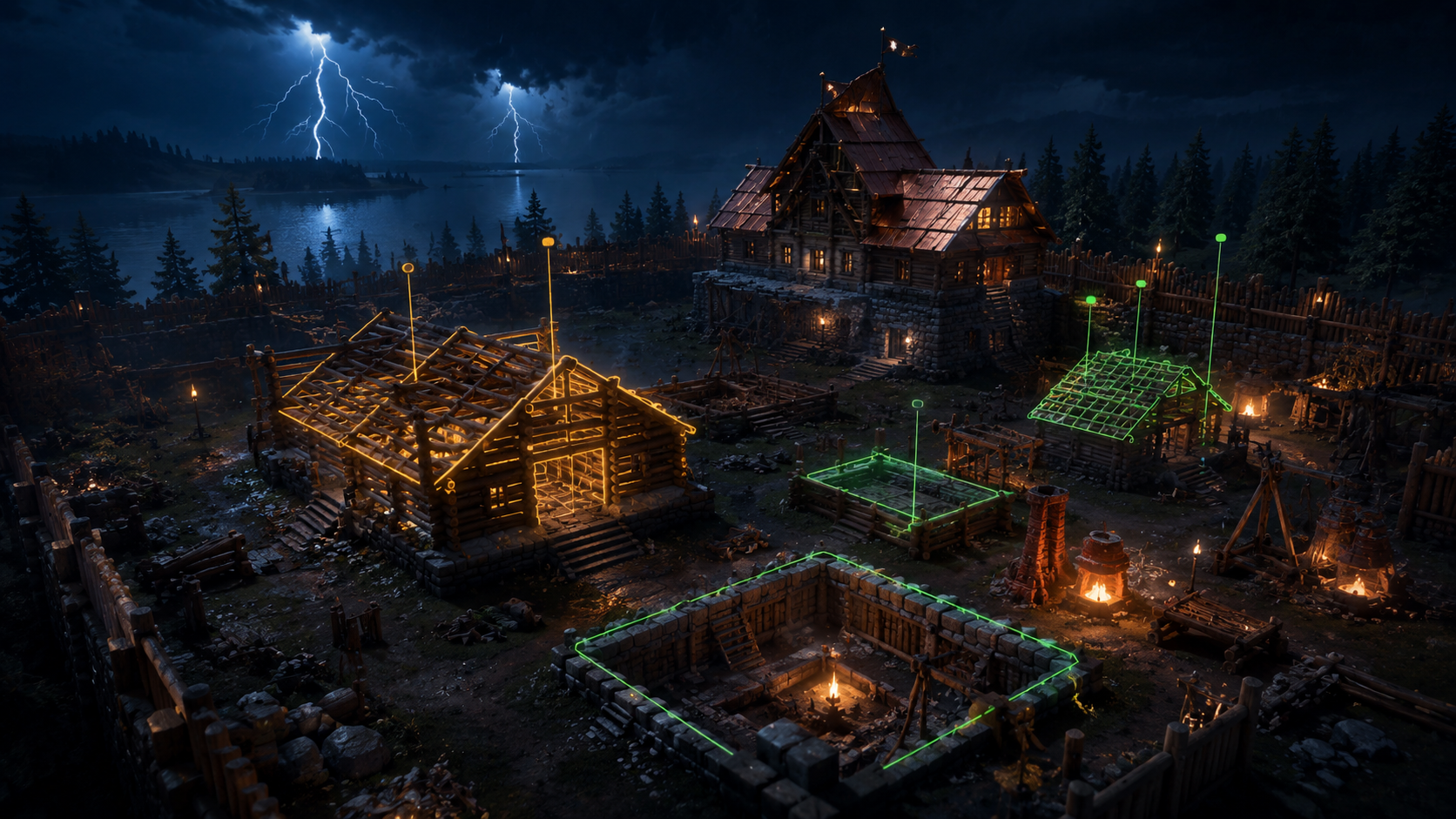
From Valheim’s timber frames to Dwarf Fortress’s fluid simulation, the most compelling building and survival games are secretly engineering simulators. Here’s what separates the games that feel real from the ones that just look like LEGO.
There’s a specific moment every veteran PC builder knows. You’ve spent three in-game days hauling stone, carefully placing your fortress walls, routing your drainage channels downhill — and then a single storm event exposes a gap in your logic you never anticipated. The water finds it. It always finds it. And in that moment, a video game has just taught you something a structural engineer could have told you: systems fail at their weakest transition point, not at the parts you reinforced most carefully.
This is not a coincidence. The best building and survival games on PC are, at their core, systems that model real-world engineering constraints — material behavior under stress, thermal and moisture dynamics, structural load distribution, the compound consequences of deferred maintenance. Some do this intentionally, with developers studying real construction principles to make their simulations credible. Others arrive at it organically, through the emergent complexity of well-designed interconnected systems.
Understanding what separates the games that genuinely model engineering from those that simply decorate it changes how you appreciate both the games and the discipline they’re drawing from.
The Engineering Problem at the Heart of Every Building Game
Every building and survival game is fundamentally solving the same design challenge: how do you create a sense of meaningful consequence from construction decisions without requiring a civil engineering degree to play? The answer — in the best games — is to model the principles of material behavior without requiring mastery of the underlying formulas.
Real construction has three failure modes that good games consistently replicate:
- Structural failure — load exceeds material strength at a critical point, causing collapse. In Valheim, unsupported horizontal spans lose structural integrity. In Dwarf Fortress, cave-ins follow actual load-path logic.
- Environmental degradation — materials break down under sustained exposure to moisture, temperature cycling, or UV radiation. In Green Hell and The Long Dark, gear and structures decay at rates influenced by exposure conditions.
- System interaction failure — individually sound components interact in ways that create vulnerabilities at their junctions. Water infiltration at transition points between roofing systems. Thermal bridging through structural members. This is the hardest to model, and the games that get it right are genuinely impressive.
Games That Actually Get the Engineering Right
Valheim
Iron Gate’s structural integrity system models load paths and span limits with genuine physical logic. Unsupported horizontal beams lose HP. Vertical columns transfer load downward. Players who understand real timber framing build better bases — not by coincidence.
Dwarf Fortress
The gold standard of construction simulation. Fluid dynamics, temperature modeling, material stress values, and cave-in physics are modeled with depth that exceeds many engineering software packages in terms of emergent complexity.
Frostpunk 2
Thermal management, insulation trade-offs, and infrastructure maintenance under extreme cold model real polar engineering challenges. The game’s resource decay mechanics under freeze-thaw cycles are more realistic than most players realize.
Green Hell
Material degradation tied to humidity and exposure time, structural weakening from moisture infiltration, and the compound effect of neglected maintenance create one of the most realistic shelter-management systems in the genre.
Satisfactory
While not a traditional survival game, its conveyor and pipe routing puzzles model fluid dynamics, flow rates, and system throughput in ways that are directly analogous to real mechanical engineering constraints.
Against the Storm
Rain mechanics that interact with building material choices, humidity affecting production output, and weather event damage that targets exposed vs. sheltered structures create a surprisingly grounded environmental engineering challenge.
Material Science in Game Mechanics: A Closer Look
The most interesting engineering modeling in games happens at the material level — how different building materials behave differently under identical environmental conditions. This is exactly how real construction works, and the games that capture it create genuinely different strategic decisions rather than just cosmetic choices.
Wood vs. Stone vs. Metal: The Real Trade-offs
In real construction, material selection is never simply about strength. A red cedar shingle outperforms asphalt in coastal environments not because it’s harder, but because its cellular structure manages moisture differently — it breathes, dries out between rain events, and resists the UV degradation that destroys synthetic materials. Copper flashing outlasts aluminum in salt-spray environments because it forms a self-healing oxide layer rather than pitting and failing. These are materials chosen for their specific failure modes, not their average performance.
The best games model this distinction. In Valheim, wood degrades when exposed to rain but resists certain impact damage better than stone. Stone doesn’t burn but is heavier, requiring stronger foundations. Metal is the strongest but demands the longest supply chain to produce and maintain. These are not arbitrary balance decisions — they reflect real material trade-off logic.
| Material | Real-World Strength | Real Failure Mode | Best Game Modeling It | How the Game Captures It |
|---|---|---|---|---|
| Cedar / Wood | High tensile, low compressive | Moisture + UV degradation; insect damage | Green Hell, Valheim | Decay rate tied to rain exposure; structural HP loss without maintenance |
| Stone / Masonry | High compressive, low tensile | Crack propagation under tension; freeze-thaw spalling | Dwarf Fortress, Valheim | Collapse logic when unsupported spans exceed limits; no fire damage |
| Copper / Metal | High ductility; oxidation-resistant | Galvanic corrosion at dissimilar-metal junctions | Rust, Satisfactory | Rust mechanic near water; maintenance costs increase over time |
| Thatch / Organic | Excellent insulation; light weight | Fire, moisture saturation, UV breakdown | Green Hell, Valheim | Burns instantly; degrades fastest in rain; cheapest to replace |
| Glass / Transparent | Compressive strength; UV transmission | Impact failure; thermal stress fracture | Frostpunk 2, Surviving Mars | Damage from storm events; heat loss in cold climates |
Where Most Building Games Cut Corners (and Why It Matters)
Understanding the engineering that the best games get right also reveals where most games take shortcuts — and why those shortcuts make the building mechanics feel less compelling over time.
The Junction Problem
In real construction, the vast majority of failures happen at junctions — the points where two different materials or systems meet. The transition between a flat roof and a pitched roof. The interface between a masonry chimney and wood framing. The seam where a wall meets a foundation. These are where water infiltrates, where thermal bridges form, where differential movement causes cracking.
Almost no PC building game models junction behavior with any specificity. You can place a stone wall next to a wood wall in Minecraft with zero consequences for the material interface. This is the single biggest gap between game construction and real construction, and closing it even partially — as Dwarf Fortress does with its moisture modeling at wall intersections — immediately creates more interesting strategic decisions.
Thermal Dynamics
Games set in cold or hot environments increasingly model temperature, but most treat it as a simple ambient stat rather than a material property. Real thermal engineering is about how heat moves through building assemblies — insulation value, thermal mass, air infiltration, and the compound effect of these over time. Frostpunk 2 comes closest to this, but even it simplifies what is in reality an extraordinarily complex interaction.
Maintenance as Gameplay
Real buildings require continuous maintenance — not just repair when damaged, but preventive upkeep that extends material lifespan. A cedar roof that is cleaned, inspected, and treated every few years lasts 40 years. The same roof ignored for a decade might fail in 15. Very few games model this distinction between damage-response and preventive maintenance as separate mechanical concepts, though Dwarf Fortress and RimWorld come closest with their wear and deferred maintenance systems.
How Real Construction Research Shapes Game Development
Several studios developing building and survival games have publicly discussed using real-world construction research to inform their mechanical design. The rationale is practical: players who have real-world experience with construction, plumbing, or structural work immediately notice when a simulation is physically wrong — and their suspension of disbelief breaks. A fluid system that fills from the bottom up rather than top-down, a structure that stands when its load path logic says it should collapse, a material that doesn’t behave the way players know it behaves in reality.
Getting these systems right — or at least directionally correct — is worth the research investment because it creates a player experience where learning the game’s mechanics feels like learning something real. The satisfaction of solving a Dwarf Fortress drainage problem comes partly from the fact that the solution would work in reality. The frustration of a Valheim collapse event comes from the same source as real structural failure: the builder made an assumption about load that the physics didn’t support.
| Engineering Concept | Real-World Application | Best In-Game Equivalent | Realism Score |
|---|---|---|---|
| Structural load paths | Column/beam/foundation hierarchy | Valheim integrity system | ★★★★☆ |
| Fluid dynamics | Drainage, pressure, flow rates | Dwarf Fortress water/magma | ★★★★★ |
| Thermal management | Insulation, heat bridging, air sealing | Frostpunk 2 heat system | ★★★☆☆ |
| Material degradation | UV, moisture, freeze-thaw wear | Green Hell decay system | ★★★★☆ |
| Junction engineering | Waterproofing at material transitions | Dwarf Fortress (partial) | ★★☆☆☆ |
| Supply chain constraints | Material sourcing, transport, staging | Satisfactory, Factorio | ★★★★☆ |
| Preventive maintenance | Scheduled upkeep vs. reactive repair | RimWorld wear system | ★★★☆☆ |
What the Next Generation of Building Games Needs
The trajectory of building and survival game mechanics over the past decade has moved consistently toward greater physical authenticity — more nuanced material behavior, more complex environmental interaction, more meaningful long-term consequences for construction decisions. The games that have led this trend have also been the ones with the most durable player communities.
The next frontier is junction modeling: simulating what happens at the interface between materials and systems, not just within them. A game that models how water behaves at the junction between a flat roof membrane and a pitched cedar section — seeking out the weakest transition point, exploiting gaps in flashing design, accumulating damage over multiple seasons — would create building challenges that no amount of brute-force reinforcement could solve without genuine systems thinking.
It would also, almost certainly, require the kind of research into real construction practice that the best studios are already doing. The line between a great engineering simulation and a great game about building is thinner than most developers — and most players — realize.
Frequently Asked Questions
Which PC game has the most realistic building and construction mechanics?
Dwarf Fortress is widely considered the benchmark for simulation depth — its fluid dynamics, temperature modeling, material stress values, and structural collapse logic go further than any other consumer game. For accessibility alongside depth, Valheim’s structural integrity system is the best example of realistic load-path modeling in a mainstream survival title. For sheer material science depth, neither game has been surpassed at their respective ends of the complexity spectrum.
Why do games like Minecraft not model structural integrity?
Structural integrity simulation adds significant computational overhead and — more critically — design complexity that can alienate casual players. Minecraft’s decision to omit gravity-based collapse (with the exception of sand and gravel) was a deliberate creative choice to prioritize free-form expression over physical realism. Games like Valheim occupy a middle ground where the system adds strategic depth without becoming a prerequisite for basic building. The right choice depends entirely on the game’s intended audience and creative goals.
Do game developers actually study real construction when designing building mechanics?
Increasingly, yes. Studios developing games with serious environmental simulation — weather-based damage, material wear, structural physics — commonly consult engineering references, building science literature, and real construction case studies to ensure their systems are directionally correct. The motivation is partly authenticity, partly gameplay quality: systems grounded in real physical logic tend to produce emergent gameplay scenarios that feel earned rather than arbitrary, which significantly improves long-term player engagement.
What is the “junction problem” in building game design?
The junction problem refers to the fact that real construction failures most often occur at the interface between two different materials or systems — where a roof meets a wall, where metal flashing meets wood framing, where a flat roof transitions to a pitched section. Most building games model material behavior in isolation but do not simulate what happens at these interfaces. Solving the junction problem — creating meaningful consequences for how players handle material transitions — would represent a significant leap forward in building game realism and strategic depth.
Which survival games best model environmental degradation of structures?
Green Hell leads the genre for organic material decay tied to specific environmental conditions — humidity, rain exposure, and temperature affect different materials differently. The Long Dark models cold-weather structural stress and insulation loss in ways that feel physically grounded. Valheim’s weather-based structural HP drain is simpler but effective. Frostpunk 2 handles extreme cold degradation of infrastructure with notable nuance for a city-builder.
Is there a PC game that models water infiltration and drainage realistically?
Dwarf Fortress remains unmatched for fluid simulation — its water physics, pressure modeling, and drainage logic can produce behavior that professional hydraulic engineers have described as surprisingly accurate. For mainstream games, Timberborn’s water system is notable for modeling flow rates and flood dynamics with genuine physical logic. No consumer game yet models water infiltration at material junctions with the specificity that real waterproofing engineering requires, though this remains an active area of development for studios working on environmental simulation.
What should builders and crafters look for in a PC survival game?
Look for games where building decisions have asymmetric consequences — where the right material in the right location outperforms a stronger material used incorrectly. This indicates that the game models material properties rather than just stat values. Also look for games where environmental events reveal the quality of your construction logic rather than simply dealing a fixed damage value. A storm that exposes your drainage design is a better challenge than a storm that reduces all structures’ HP by 20%. The former rewards engineering thinking; the latter rewards grinding materials.
Are there PC games specifically designed around real architecture or engineering?
Several games occupy this niche. Poly Bridge and its sequel model structural physics — specifically bridge tension and compression — with enough accuracy to be used as educational tools in engineering curricula. Hydroneer and Stationeers model fluid and gas dynamics for engineering-minded players. On the architecture side, games like Cities: Skylines 2 incorporate urban planning principles that align with real infrastructure design. The genre is maturing rapidly, with increasing crossover between genuine engineering simulation and mainstream game design.
The Best Building Games Are Engineering Simulators in Disguise
The satisfaction you feel when a Valheim longhouse survives its first Fuling raid, or when a Dwarf Fortress drainage canal finally routes floodwater away from your great hall, comes from the same place as the satisfaction a real engineer feels when a system performs as designed under unexpected load. It’s the pleasure of correctly predicting how a complex system will behave — and being right.
The games that create this feeling most reliably are the ones that took the time to understand real engineering principles and encode them faithfully enough that learning the game’s mechanics feels like learning something transferable. The line between building a great game base and understanding why real buildings stand is thinner than most players realize — and the best developers know it.
Next time a storm rolls through your base and finds the one gap in your roof design you didn’t think about, take a moment to appreciate it. That’s not bad game design. That’s engineering.